
Canadian author David Day has been supplying the world with books — and not only books about Tolkien’s work — for almost fifty years. Some readers swear by him, as shown by the lasting interest in his publications; others tear him apart and, perhaps somewhat blindly, repeat the opinions of others.
The truth remains that people buy his books, admire their picturesque illustrations, which are not influenced by any commercial work, and which also have a Czech connection.
When I approached David Day for an interview, I did not expect such a fruitful discussion to develop from it — and I was not afraid to poke the hornet’s nest. The truth remains that we often do not know the author’s own point of view, and that while we overlook inaccuracies in other books, many people look at this Canadian dreamer with a critical eye from the very beginning.
And did you know that David Day actually helped launch Alan Lee’s career? And what does he say about Czech illustrators? Read this exclusive interview by Starý Bral and let me know what you think about the books — and, most importantly, why.
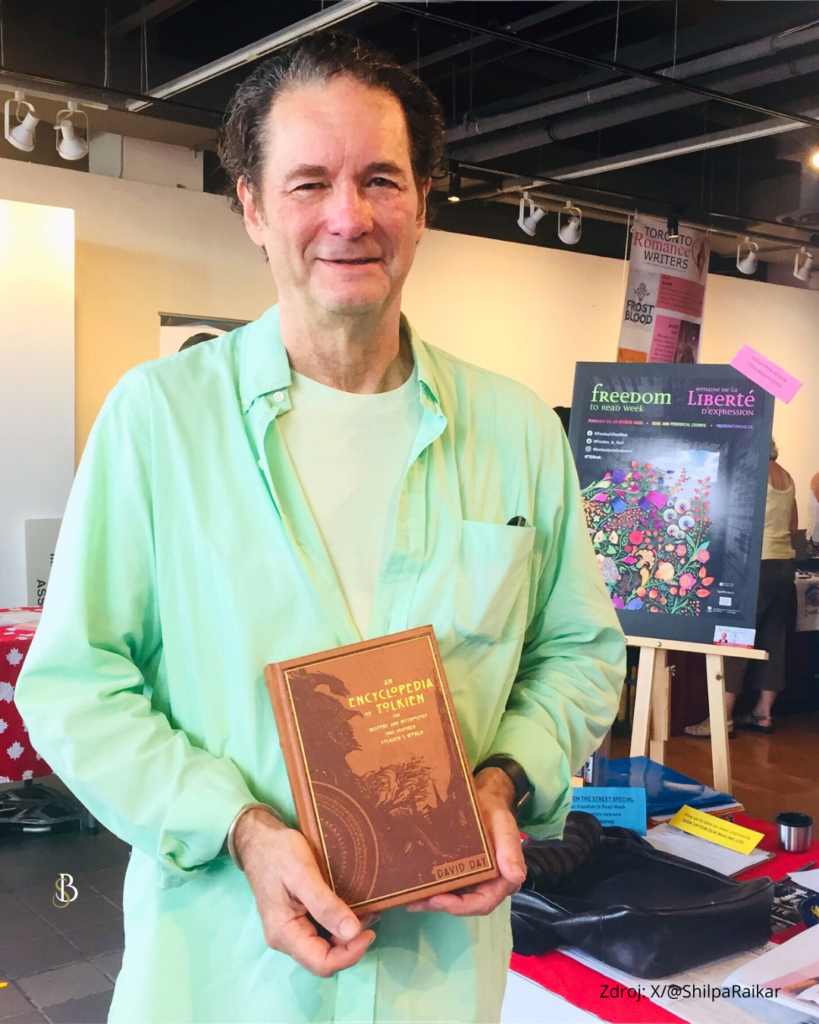
If you met yourself and had to introduce yourself, what would you say?
How would I introduce myself? Simply by my name, and if we were not in my home country, I would explain that I am a Canadian currently living on Vancouver Island but have lived in Britain and Europe for half of my adult life. Also, depending on the individual – what their occupation was, or general interests – I might say I am a writer; although I found I provoke more interest if I confess that for a number of years, I was a logger (aka lumberjack). If asked: “What kind of writer?”, I usually explain that I have written in a number of genres: poetry, fiction, fantasy, children’s books, non-fiction and journalism. In certain communities and contexts, I am known for my environmental books and journalism; or my children’s books. To the more eccentric and peripheral audience of fellow poets, I am known for my poetry. However, as general readers most often ask: “Anything I might have read?” I explain that I have written a series of books on the life and works of J.R.R. Tolkien, not because I expect them to know my name, but I am certain they will know Tolkien.
When people hear the name David Day, almost the entire world immediately associates you with Tolkien. What does that mean to you?
No, I don’t believe most people immediately associate the name David Day with Tolkien. Of course, I am delighted if I occasionally get a response to a title like: “Oh you wrote that book, my father gave it to me as a kid, and I loved it.” Obviously, a considerable number of people have enjoyed reading my books on Tolkien which does give me some pleasure, but I don’t believe most people give much thought to who wrote them. And that is as it should be, they are not about me, but were created as guides to make Tolkien’s world accessible and enjoyable to the general public.
You published Tolkien Bestiary as early as 1979, two years after The Silmarillion. How did you come to the subject at that time? Was it an immediate idea?
Yes, I have always been interested in world mythologies, so when The Silmarillion was published in 1977, I found myself fascinated by the depth and complexity of Tolkien’s world-building ability to create an entirely unique mythology. However, the same depth and complexity that I found so engaging in The Silmarillion was – initially at least – something of a barrier for many general readers who were expecting a second ‘adventure’ novel akin to The Lord of the Rings. In 1978, reflecting on my studies in medieval and renaissance literature, I found the most popular category of secular manuscripts and early printed books were bestiaries: wonderfully illustrated exotic natural histories of real and mythical creatures of the world. These were carefully catalogued descriptions and illustrations of tigers along-side unicorns, elephants and dragons, mermaids and manatees. Many included exotic races and tribes of people both real and imagined, as well. This seemed to me to be an ideal way to introduce readers to the natural and supernatural inhabitants of Tolkien’s medieval-adjacent world of Middle-earth. One reader’s review that continually brings a smile to my face is for one of my guide books: “Maaaan, where was this when I struggled through The Silmarillion? It would’ve been much easier to follow the narrative. Don’t get me wrong, I love The Silmarillion, but it was a challenging read. Well, I guess I’ll have to reread it now.” This instantly warmed my heart and was exactly the response I had most hoped to evoke in my readers.
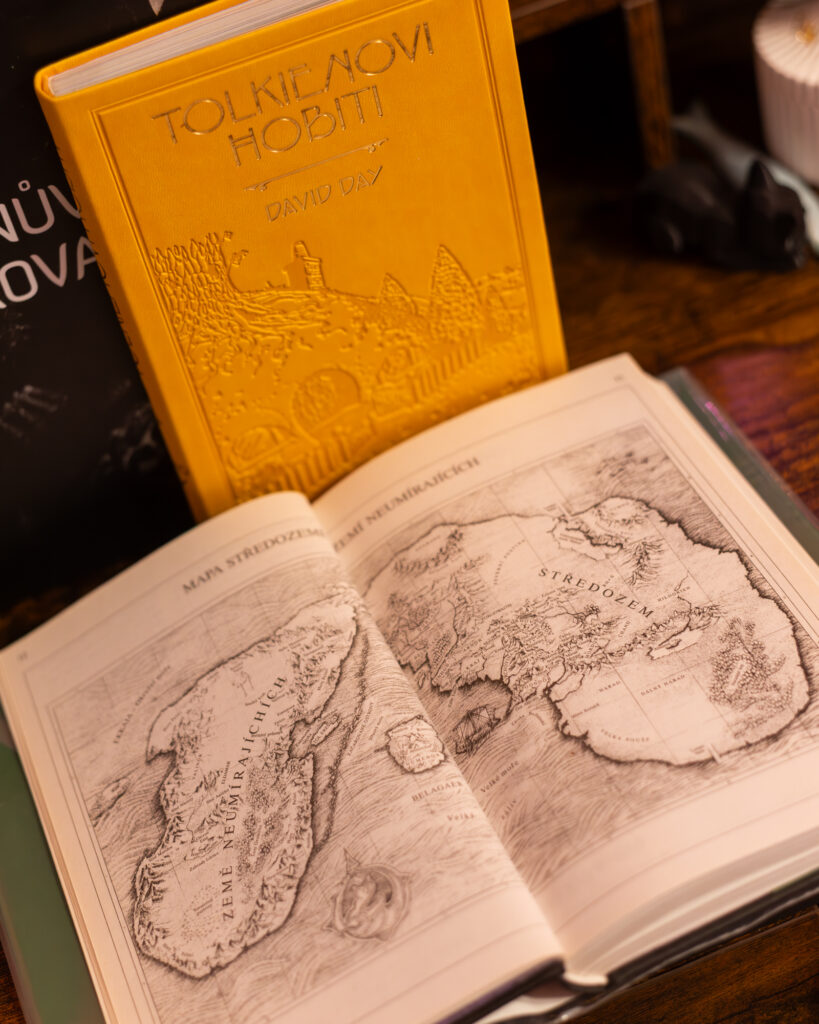
For many readers, Tolkien Bestiary was, and still is, a landmark book in your work. How do you look back on it after all these years?
Yes, I believe A Tolkien Bestiary is something of a “landmark book” as it certainly was the first illustrated guide to Tolkien’s world. It’s brilliant art director Debra Zuckerman enthusiastically embraced the concept of a bestiary. She created a unique typeface for the book and exclusively commissioned some of the finest and most promising fantasy artists in Britain and Europe at that time. The only other Tolkien reference work that took into account The Silmarillion was Robert Foster’s updated Complete Guide to Tolkien published in 1978. This was an extensive annotated index of Tolkien’s names of persons, places and things. Excellent for serious researchers, but unlike the Bestiary was without the illustrations, maps or time charts that I believed would make Middle-earth more accessible to general readers. Also, I purposely wrote it in a highly descriptive “medieval” (at times, even poetic) style – akin in tone to that of Tolkien’s Silmarillion – that I hoped would engage general readers. [To observe the contrast in writing styles, one might wish to compare the Bestiary Dragon entry with that of the Dragon entries in Foster’s Guide.]
Even back then, the book was illustrated by artists who were less well known at the time, including some Czech illustrators. How did you discover these illustrators, and how did you communicate with them back then? Moreover, you continue to place great importance on the visual side of your books, which sets you apart from much of the competition, doesn’t it?
Yes, there were many young up and coming artists recruited for the Bestiary. The most prolific and original was Ian Miller whose illustrations had the look of cut-steel engravings and really set the tone for the bestiary with his sinister Dragons, Dwarves, and Orcs. Our Dutch artist Lidia Postma was our definitive Hobbit artist; while the already celebrated Hungarian-born Victor Ambrus was assigned the portrayal of the Elves and Men. The remarkable English artists Michael Foreman and John Blanche were recruited for their skills in creating dramatic sweeping landscapes. And of course, the excellent Czech artist Jaroslav Bradáč produced the many brilliant portrayals of the Valar and the Maiar: the ‘gods’ and ‘demi-gods’ of Middle-earth. Since then, over nearly five decades, there have been over three dozen multi-national artists commissioned to create art in subsequent Tolkien-themed books. It has been one of the greatest pleasures of my life to create beautiful books in collaboration with so many wonderfully talented artists. I became — and continue to be — personal friends with many of these artists.
Since we are speaking about illustrators, The Tolkien Ring was created with Alan Lee. How do you remember that collaboration, including your work together on Castles?
In 1981, at Alan Lee’s urging, the publisher Ian Ballantine approached me with the idea of collaborating with Alan on a proposed book on Castles. Evidently, Alan had seen and liked the style of my writing in the Bestiary and thought we would be a good match. Alan and I first met up at the Ian and Betty Ballantine’s country home in Woodstock in Upstate New York where we sat around a table with the designer David Larkin and some of Alan’s spectacular illustrations and mapped out a plan on how to proceed with the project. In I984 and 1986 Alan illustrated two of my small press poetry books The Animals Within and Gothic – and later still, he contributed illustrations to my large format Quest For King Arthur. However, it was in 1994 when we collaborated on Tolkien’s Ring, a study of the mythological sources of Tolkien. This was Alan’s first excursion into Middle-earth as an illustrator, but of course as our publisher for that book was the Tolkien Estate’s own publisher HarperCollins, the editor and the Estate soon recognized Alan as the perfect illustrator for Middle-earth. Consequently, they scooped him up as the official illustrator of The Lord of the Rings, and subsequently nearly all new editions of Tolkien’s books.
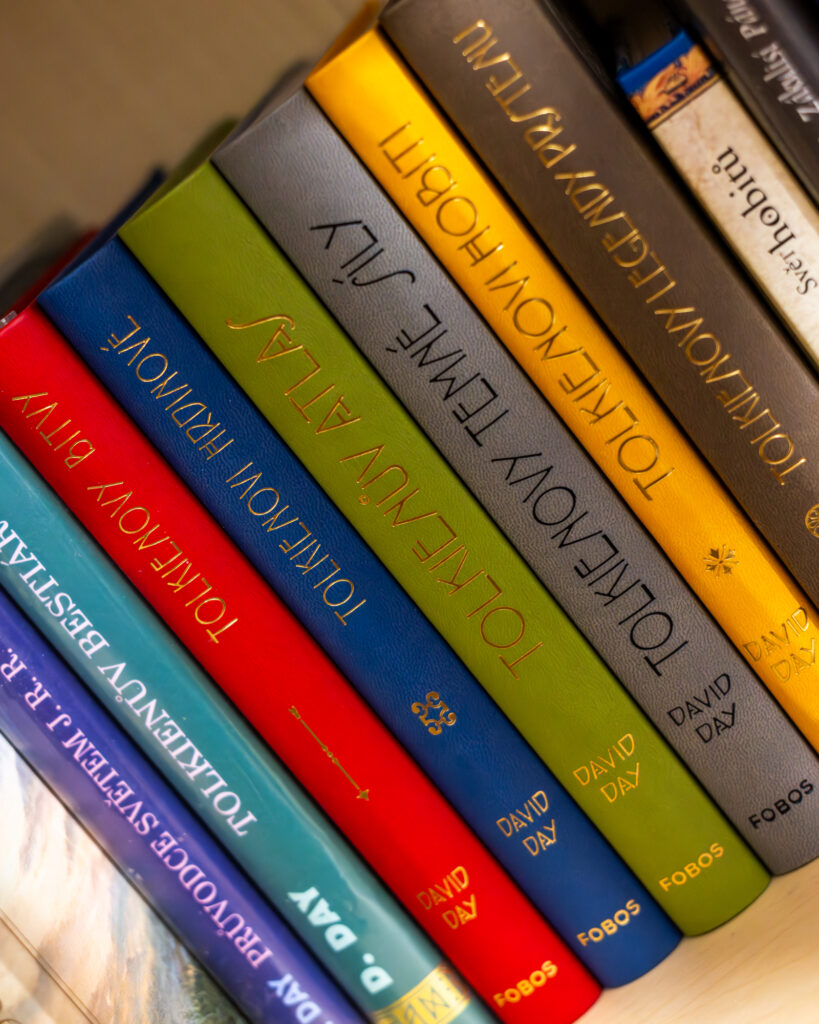
You have published almost 20 books about Tolkien. Have you already exhausted all the possible topics? Can you reveal what you are working on next? And which of all your books is your personal favourite?
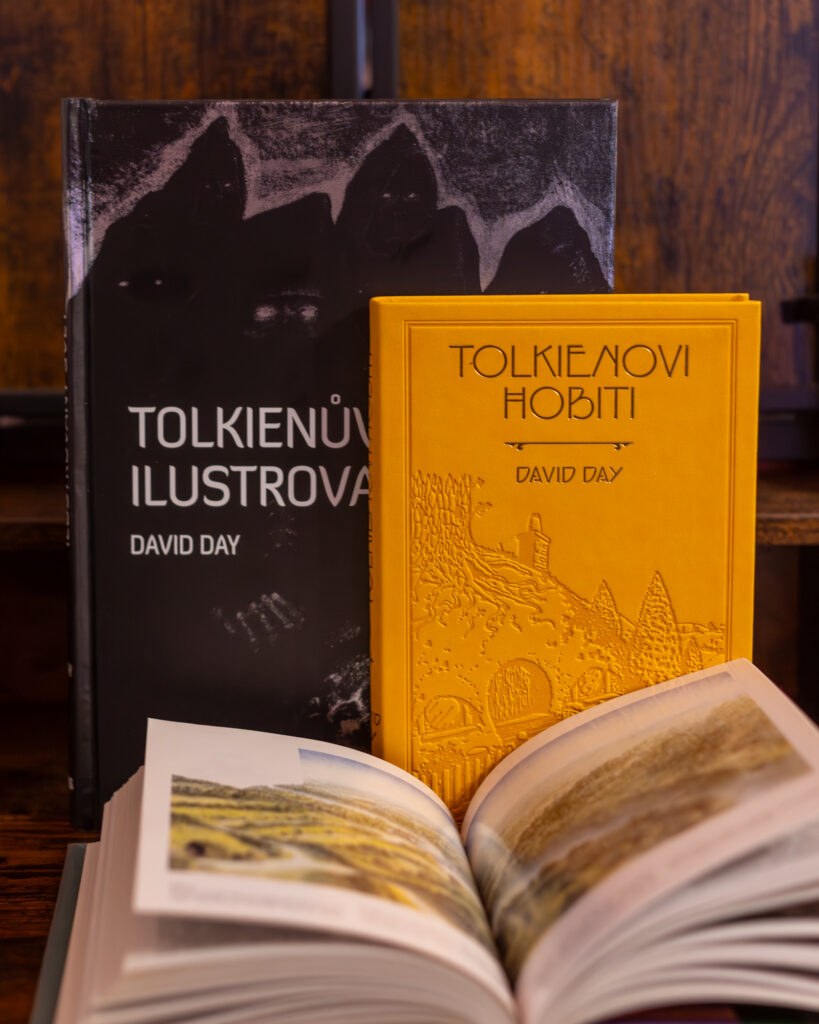
I am currently working on a larger, redesigned edition of The Hobbits of Tolkien, as my publishers have decided to do a deluxe quarto-sized (24x30cm) edition. This new hardcover volume is to be expanded by 64 pages with 20+ new illustrations and approximately six thousand more words of text. It also features gold-trimmed pages and a satin marker ribbon. As to new ideas: I have been working for a number of years on an
ambition project which takes an entirely new and unexplored approach to J.R.R. Tolkien’s cosmos. However, at this time, I must keep that project tightly under wraps until it is closer to completion. As to which of my books is a personal favourite: this to an author is like asking a father to choose and publicly name a favourite child! I want to say I love them all of my Tolkien offspring, but must acknowledge my first-born aesthetically beautiful A Tolkien Bestiary does have a special place in my heart.
We began by saying that you have now become almost synonymous with Tolkien. Nonetheless, I often come across the opinion that your books can be inaccurate, or that they give too much space to your own ideas. How do you perceive this criticism? And why do you think you, in particular, are such a frequent target, when dozens of books on J.R.R. Tolkien are published every year, many of which surely do not reach the quality of your work? Do such criticisms, on the contrary push you further to that you correct possible inconsistences in your later books?
First of all, I wish to say I do feel blessed and delighted that my books have proved to be popular and so much appreciated by so many readers world-wide. Ultimately readers make up their own minds. I’m encouraged that roughly 95% of reader reviews on Amazon and Goodreads have been extremely positive (4-5 stars out of 5) which suggests the book is resonating with the audience it was written for. I also truly appreciate the many readers ho contact me directly with personal stories and positive feedback. Unfortunately, the Tolkien Gateway leadership and community appears to have amplified less positive reviews and have led a very vocal minority in their public online arena to give the impression that they represent the dominant or authoritative view. And perhaps in this context, it may be worth comparing my biography on the Tolkien Gateway to my rather standard editorially-neutral biography in One Wiki to Rule Them All.
Inaccuracies: I dispute nearly all of these “inaccuracies” and it would take a dozen or two pages to list and correct the false accusations promoted by Tolkien Gateway and their online allies over the years, but let us take one of the most infamously obvious: the decades-long attack on my Tolkien Bestiary 1979 Map of Middle earth and the Undying Lands which is “criticized for differences from Tolkien’s own maps such as Map V from the Ambarkanta maps”. This would be a valid criticism if it wasn’t for the fact that the Ambarkanta was not published until 1986 – seven years after the Bestiary map was published.
Furthermore, the 1979 Bestiary map is clearly sub-titled “A Composite Map of Arda Through the Ages” and as carefully explained in the introduction this is ‘an original interpretation from Tolkien’s writings and should be used only for general orientation. It shows all the lands of Arda, even though many of them… did not exist at the same time… [and] vanished completely by the time of the Lord of the Rings.” So, Gateway’s explanation that the map is invalid because I was unaware of the fact that many of the lands did not exist at the same time ignores both the map’s subtitle and its clearly stated introductory explanation. Far from being an error, the entire unique purpose of this map was (and still is) to allow readers to discover where the many vanished First Age realms in The Silmarillion might be roughly located in relation to the landmass shown in The Lord of the Rings map in the Third Age. This map was also supplemented by two extensive time charts to help provide a chronological orientation of those realms and consequently allow readers to link up the histories revealed in the First Age Silmarillion with those in Third Age Lord of the Rings. And at the time, it should be noted that it was the only interpretive map of the world of Arda.
The lesser complaint that Númenor is not star-shaped in the 1979 Bestiary map can be similarly explained by the fact that there was no published map or mention of Numenor’s star-shaped geography until 1981. As to the location of sunken land of Beleriand, this was simply a solution to a logistical problem. Tolkien’s First Age Beleriand and his Third Age Middle-earth roughly occupied the same region of the northwest of Middle-earth. So, in order to include the shorelines of both those maps in this composite rendering, the sunken First Age Beleriand was lifted from the sea bottom and shifted just to the north of the Third Age Middle-earth landmass.
The question really is why would Gateway, from 2004 to 2026, have continuously complained about a now five-decade old map, when in 1991 (when the Bestiary went out of print, and the Illustrated Encyclopedia was meant to update and replace it) there were 12 maps showing the evolution of Middle-earth; and then in 2015, when we published an entire Atlas – both extensively integrating elements of the Ambarkanta maps?
Furthermore, The Atlas of Middle-earth by Karen Wynn Fonstad is recommended by Gateway. However, this ignores the fact that Fonstad’s map was originally published in 1981 when – like the 1979 Bestiary map – it obviously also differed from the Ambarkanta maps. So, Gateway appears to accept the changes in the Fonstad maps in 1991 as definitive, but then ignores the changes in my maps in 1991 and 2015.
Sorry for this prolonged explanation, however, this is not just a minor oversight. It is part of a catalogue of false claims made over the years. Most of these “errors” relate to nonsensical and ill-informed quibbles akin to the infamous “Do Balrogs have Wings?” controversies that poisoned the fandom internet for years – a question that Tolkien himself dismissed as absurd. But one might ask, what possible difference do these tedious nit-picking disputes make to anyone’s appreciation of J.R.R. Tolkien or his world? I could easily (if you wish specifics) counter each one of Gateway’s most recent absurdly trivial list of “errors” by me: Beren, Giants, Long-worms, Sauron, Telcontari; or
their earlier lists that included: Tom Bombadil, Shelob, Snowmane, Felarof, Glorfindel, Dragons, Galadriel, Kraken, Celebrian, Ages of the Sun often recited by its “critics”.
Too much space to my own ideas: Any speculations made in my books are most often based on drawing parallels with world mythologies, literatures and ancient traditions that were very much a part of Tolkien’s intellectual life. And indeed, it was through those studies that that he creatively breathed imaginative life into the fictional world of Middle-earth. Consequently, I make no apologies for opinions and analogies based on a lifetime of study of the historical and literary traditions that were undoubtedly major sources of inspiration in Tolkien’s creative life.
How do I perceive this criticism? Since the advent of the internet, I have been relentlessly trolled over the last three of the past five decades. However, fortunately these attacks have been limited to the internet. For over all these years, internationally the mainstream print press has nearly always positively and enthusiastically reviewed my books. And, curiously enough, from 1979 to the mid-90s, I was warmly embraced by the Tolkien Society. In 1979, the editor of Amon Hen’s review (#42) of A Tolkien Bestiary begins: “This is a magnificent book.” In 1984, in Amon Hen #70 refers to “David Day, the author of the much-praised Tolkien Bestiary.” In 1991, in Amon Hen #114 a review of Tolkien: the Illustrated Encyclopedia: “To sum up, this book is designed to be as much read and enjoyed as it is to be referred to…. well written and presented and I think will prove wholly successful.” I did not actually use the internet (aside from e-mails) until 2008, so I missed out on a decade of random online abuse before learning I had been blacklisted by the Tolkien Society in 2004 due to an administrative error.
And why do you think you, in particular, are such a frequent target, when dozens of books on J.R.R. Tolkien are published every year, many of which surely do not reach the quality of your work? The considerable popularity of my books has obviously drawn the critical attention of the Tolkien Gateway and its allies. I don’t wish to speculate on their motives here. However, I have attached my recent e-mail sent to the founder, chairman and each board member of Tolkien Gateway politely requesting amendments to my biography in line with the organisation’s published guideline and standard practice for other living authors. To date, I have not received a response or acknowledgement.
Even so, Shaun Gunner of the Tolkien Society – which is often critical, and where you are perhaps somewhat blacklisted – praised the Battles of Tolkien, saying that. You had corrected facts and made the information more precise. Do words of praise please you?
This actual wording of this review begins with a series of false premises before it combines some acknowledgement of factual accuracy, but then concludes with an entirely dismissive critique of my book’s analysis. I am less focused on whether feedback is flattering and more interested in whether a review is rational and fair. Certainly, I would have preferred this reviewer had focused on actual examples of book’s historic and literary analysis rather than what I perceive to be a series of unsubstantiated judgements.
The vast majority of your works have been published in Czech, and many of them include Czech artists. What message would you like to send to Czech illustrators? Which of these illustrators is your favourite one?
As to Czech artists: my favourite Jaroslav Bradáč’s illustrations on his Steppenwolf projects first drew our attention to his work as seemed to integrate a psychological element into his illustrations. This certainly was achieved in his work on the Valar and Maiar. His death’s head of Morgoth and the terrifying Eye of Sauron have established themselves as classics of evil portraiture. Always on the lookout for new talent, much later, around 2018 my editor (over the last decade) Lucy Pessell discovered beautiful
watercolour landscapes by the young Czech fantasy artist Šárka Škorpíková. It was felt that her work could bring out the gentler, more lyrical aspect of Middle-earth’s geography that would prove to be a welcome contrast to the dramatic carnage of the many of battlefield landscapes.
When David Day has some free time, which book by J. R.R. Tolkien does he reach for?
Although I don’t recommend it for the faint-hearted, Christopher Tolkien’s exhaustive multi-volume editing of his father’s papers in the History of Middle-earth series is always insightful and inevitably leads on to further investigation.
One final question, do you know in which of the Tolkien’s books a character named Mr. Day appears?
Yes, naturally, I was aware of Mr. Day in Tolkien’s children’s tale called Mr. Bliss. If I remember correctly, Mr. Bliss crashes his new motor car into Mr. Day (and later Miss Knight). Mr. Bliss appears to be something of a self-mocking fictional version of Tolkien himself who was a famously terrible driver. And both Mr. Bliss and Mr. Tolkien, after a number of crashes and scrapes turned in their cars for bicycles. I believe there was a happy ending for Mr. Day who marries Miss Knight and opens a grocery shop called “Day and Knight.” I suppose I found the story personally amusing on a couple of counts. For a short time during my childhood, my stepgrandmother – who was also a terrible driver – ran a shop called “Day’s Groceries”. But more significantly, a Mr. Day – my paternal grandfather – was born in Wolverhampton in the 1890’s, just a two-hour bike ride from J.R.R. Tolkien’s childhood home in Sarehole, Birmingham.
Thank you so much!
Appendices
E-mail to Tolkien Society
Tolkien Society Reviews